How AI-Based Conversational Inventory Reporting Works in Practice
Traditional reporting relies on rigid structures: pre-made reports with built-in filters, each report created for a specific purpose.
With 25+ reports in an average inventory software it is not always easy to find the right report and get the results you need.
Conversational natural language processing (NLP) interface in the QR Inventory software changes this approach.
It allows users to ask for data they need using simple prompts.
You can ask questions like these:
- "What is our current stock of copper pipes in the Idaho warehouse?"
- "Identify all tools that need reordering based on minimum stock levels."
- "Show equipment with warranty expiration dates in November 2026."
- "List all deliveries received from XYZ Inc. in the last 30 days."
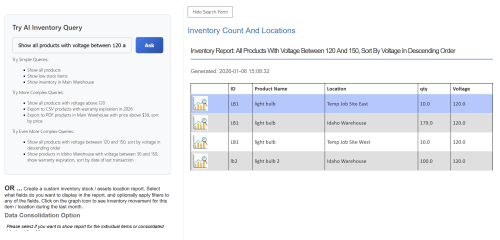
- "Generate a .csv file of metal rods in the main warehouse with length between 5 and 15 inches."
Behind the scenes, the Natural Language Processing (NLP) engine identifies your specific intent and filters
(such as dates, locations, or dimensions), and pulls live data into a clean, structured table.
You can review the data via the web dashboard or export them to .csv files for sharing and importing into internal software systems.
How AI-Based Natural Language Reporting Compares To Traditional Inventory Reports?
Natural language reporting offers a dynamic, flexible alternative to traditional, form-based reports.
It provides direct answers to users' questions, eliminating rigid structure of traditional reports, reducing software learning curve and training needs.
Traditional Inventory Reports
Traditional reports require users to:
- Know which report to run
- Select the right filters and fields
- Understand inventory structure and terminology
- Rebuild reports for every new question
AI-Based Conversational Inventory Reports
Natural language inventory reporting removes the complexities, turning accessing inventory info from a technical task into a simple conversation.
- Users ask for what exactly they need, without trying to locate the right report
- Users can specify what data to display, how to filter and order data
- Users can indicate if the want to review reports online or download
- AI engine interprets the request and produces data that user asked for, in the format he wants
- No technical knowledge or training is required
How Does Natural Language Processing (NLP) Improve Inventory Decision-Making?
In most modern inventory systems, the challenge is not a lack of data - it is the time users should spend to find what they need.
Traditional reporting requires users to know exactly which pre-made report to use and which filters to toggle to get an answer.
Conversational NLP-Based inventory reporting replaces navigation with direct inquiry:
- Eliminate Complex Navigation Instead of sifting through categories like "Stock Levels by Location" or "Asset Aging Reports,"
you simply state what you want to see in plain English. The AI does the heavy lifting of identifying the right data source for you.
- Custom Views Without Configuration Traditional reports are built on fixed templates. If you need a specific data view,
for example "show serialized assets delivered to Job Site B yesterday", you don't have to spend 10 minutes configuring complex filters. You just ask.
- Follow-up Questions: Inventory analysis is rarely a one-step process. In a standard system, a follow-up requires adjusting a
new set of filters. With AI-based natural language reporting, you can refine the view by asking follow-up questions, for example
"Now filter that list by assets under warranty" or "Group those results by supplier."
This shift moves your team from being "Software Operators" who manage report templates to "Decision Makers" who simply use data.
Operational Impact of AI-Based Intelligent Inventory Reporting
Moving to conversational reporting changes the pace of your day-to-day operations by removing the friction between needing an answer and finding it.
-
Data access without work interruption With NLP reporting a user can ask for data he needs, get the answer in seconds and get back to the job
at hand. he does not waste time on navigating menus and building filters.
-
Ad Hoc inventory queries Sometimes you may need an answer to the one-off question that a standard "Stock Summary" reports do not handle.
Natural language reporting can handle this without requiring you to create a new report from scratch.
-
Consistent inventory info Users can ask the same question in different ways. Natural language reporting is good at
handling these variations. It produces the same result for semantically similar questions,
reducing misinterpretation and conflicting data.
-
Fast new employees onboarding Availability of conversational AI-based reports reduces the inventory system learning curve. It eliminates
the need to learn report builders, filters, or system-specific terminology.
-
NLP provides foundation for reporting automationAI-based reporting engine can remember user queries, produce automated summaries,
and provide other enhancements that
simplify and speed up data access for company employees.
How Natural Language Inventory Reports Work In The QR Inventory Software
1. User Asks a Question in Natural Language
The user types in request using plain English, for example:
What inventory is low in Warehouse A?
Show materials allocated for job 214
List equipment currently in use on job site XYZ
What parts does Joe have in his truck?
No report selection, filters, or technical terminology are required.
2. NLP Engine Interprets Intent and Key Details
The NLP engine analyzes the question to determine key details:
- The user's intent, for example check stock, review inventory transactions, or check usage history
- Relevant parameters, such as item names, locations, jobs, dates, quantities, custom fields
- What user wants to include in the report, and how he wants to review it (online, download)
3. Inventory Data Is Queried in Real Time
- The interpreted request is converted into a structured database query.
- Live inventory data is retrieved as required.
- Access controls ensure users only see data they are authorized to view.
4. Results Are Returned in a Clear, Actionable Format
The system presents results as requested - for online viewing or download.
The interaction feels conversational, not transactional, making reporting faster and more intuitive.
Who NLP-Based Inventory Reporting Is For
NLP-based inventory reporting is designed for organizations that need fast, reliable answers from their inventory system,
without requiring technical expertise or complex reporting workflows.
-
Operations and Warehouse Managers
Get quick visibility into stock levels, shortages, and inventory movement across locations without running predefined reports or relying on support staff.
-
Field Teams and Job Site Supervisors
Access inventory information directly from job sites or service locations using mobile devices, without navigating complex reporting screens or dashboards.
-
Business Owners and Executives
Get high-level inventory insights, trends, and exceptions through simple questions - without needing detailed system knowledge or manual report setup.
-
Non-Technical Staff and New Users
Enable broader access to inventory data by allowing anyone to ask questions in plain language, reducing training time and dependence on power users.
-
Growing Organizations With Increasing Complexity
Scale reporting as inventory grows across more locations, items, and transaction types—without constantly rebuilding or maintaining report templates.
Why Natural Language Reporting Is the Future of Inventory Management Systems
Inventory systems are not judged by how much data they store, but by how easily people can access and use that data.
As business operations become more distributed, fast-moving, and mobile-driven, traditional reporting models are falling behind.
AI-based natural language inventory reporting represents a shift from interface-driven systems to intent-driven systems -
where users interact with inventory software the same way they communicate with colleagues.
NLP Converts Static Reports to Continuous Insight
Traditional inventory reporting is built around predefined reports and dashboards that must be designed, maintained, and periodically revised.
NLP-based reporting replaces that static model with a dynamic one, where insight is generated on demand based on the question being asked.
This enables continuous access to relevant information instead of manually rebuilding queries as needs change.
NLP Reports Support Mobile, Voice-Based Workflows
Modern inventory systems must support the way people work - on the job sites, in the warehouses, being n the middle of active operations.
Natural language reporting aligns naturally with the
mobile and voice-based interfaces,
making inventory info accessible even when screens, keyboards, or complex menus are impractical.
As voice input and hands-free workflows become more common, NLP reporting becomes a foundational capability rather than an optional feature.
NLP Reporting Reduces Complexity Of Inventory Management Systems
As companies and their inventory management needs grow, reporting logic often becomes fragmented - spreadsheets, custom reports, saved filters,
and manual workarounds accumulate over time. NLP reporting centralizes data access, reducing the need for ongoing report maintenance
and simplifying long-term system management. This keeps reporting usable as inventory needs evolve, without system customization or changes.
NLP Engine Enables Smart Automation and AI Agents
NLP reporting is a stepping stone toward more advanced inventory automation. Once a system can understand questions about inventory,
it can also monitor conditions, summarize trends, and trigger actions automatically.
This creates a foundation for
AI inventory assistants
that don't just answer questions, but can take on manual tasks, such as inventory replenishment, fulfillment monitoring, and optimizing inventory levels.

