QR Inventory Overview
Real-Time Inventory Visibility and Automation for Field Operations
QR Inventory is a mobile-first inventory management and asset tracking system designed for companies that need more than a basic stock-counting app,
but want to avoid the complexity, high cost, and rigidity of traditional ERP systems.
The platform provides a highly configurable framework managed via an intuitive admin dashboard. From multi-location asset and inventory management to Work-in-Progress (WIP) tracking,
QR Inventory adapts to your unique business logic, while remaining fast to deploy and simple for field crews to use daily.
Why Businesses Choose QR Inventory
With QR Inventory, your workflows can be as simple or complex as your business demands, while the system remains effective and easy to use for field and warehouse employees
due to an intuitive flow and a natural language interface:
- Voice Commands & Bulk QR Code Scanning for Fast Inventory Processing: Simplify and speed up field inventory management tasks
with natural language voice interactions and bulk QR code scanning in the QR Inventory mobile app.
- Inventory & Tool Tracking Anywhere: Track tools, equipment, and materials in real time
in the field, across
warehouses,
service trucks,
job sites, and the manufacturing shop floor.
- Automated 24/7 Asset Monitoring Using BLE/IoT: Reduce manual work and human error with continuous, automated IoT asset monitoring.
- Fast Software Deployment, Simplified Daily Use & Reporting: Configure QR Inventory fast with a custom walkthrough session and AI-guided onboarding,
simplify daily use and reporting with built-in
AI Assistant.
- Replace Paperwork with Digital Mobile Forms: Replace manual field notes with dynamic mobile forms and checklists, automatically routing
structured data to your centralized cloud database.
- Integrations With Internal Software: Automatically transfer inventory data to your accounting and project management systems.
What Makes QR Inventory Different
QR Inventory vs. Basic Inventory Apps: Unlike basic applications, QR Inventory supports complex operational workflows, customizable processes, real-time visibility, and advanced automation.
QR Inventory vs. Traditional ERP Systems: Unlike traditional enterprise software, QR Inventory can be deployed in days rather than months, requires
minimal staff training, and is built specifically for practical, agile mobile use in the field without enterprise overhead.
Table Of Contents
Core QR Inventory Software Capabilities - Mobile Inventory Tracking With Real-Time Stock Visibility
Fast Field Inventory Tracking with Voice and Mobile Scanning
Real-Time Inventory Visibility Through A Centralized Cloud System
Accurate Inventory Records With Instant Real-Time Synchronization
Improved Materials Planning and Purchasing With Inventory Analytics
Automated Inventory Management With Smart Tags & Trackers
Inventory Management Automation & Intelligence Tools
Reduced Manual Work With Automated BLE/IoT Asset Monitoring
Fast Software Deployment And Simplified Daily Use With AI Assistant
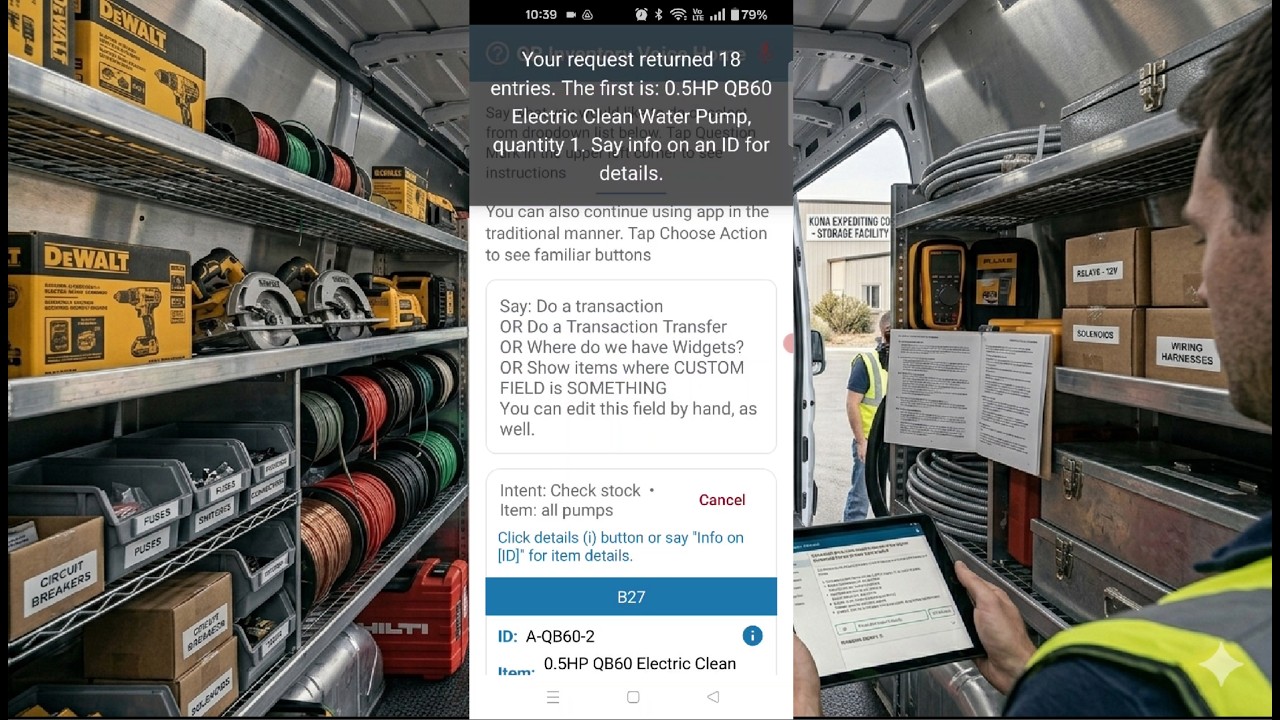
Fast And Easy Mobile Inventory Tracking With Natural Language Voice Interaction
Inventory Workflow Customization, Data Collection, and Traceability
Adapt Inventory Management Process To Your Business With Customizable Workflows
Speed Up & Automate Paperwork With Mobile Forms and Checklists
Control Production Processes With WIP Tracking and Traceability
Implementation, Scalability, and System Integration
Customize Inventory Software Functionality With Add-On Modules
Reduce Training Needs & Increase Software Adoption With Simple & Intuitive Interface
Deploy Inventory Software in the Environment That Fits Your Business
Reduce Manual Work By Connecting Inventory Software With Accounting and Project Management
Core QR Inventory Software Capabilities - Mobile Inventory Tracking With Real-Time Stock Visibility
QR Inventory core capabilities - mobile inventory tracking and real-time materials and tool visibility through a centralized cloud platform -
help businesses reduce manual work, improve field-office coordination, reduce tool loss and project delays due to materials shortages.
Fast Field Inventory Tracking with Voice and Mobile Scanning

QR Inventory turns Android and iOS smartphones and tablets into intuitive mobile tools designed to accelerate data entry and create accurate, real-time inventory records:
- Real-Time Mobile Data Capture: Field and warehouse employees record inventory transactions in real time, with QR code scanning and voice commands, ensuring that inventory data is always up-to-date.
- Instant Asset Info Access for Field Productivity: Field technicians can instantly access live stock levels, technical drawings, specifications, and user manuals with a voice query or a quick QR code scan, reducing downtime and preventing project delays.
- Natural Language Voice Support for Speed & Simplicity: QR Inventory natural language voice support, coupled with bulk QR code scanning
makes field data access and capture significantly faster and easier than in traditional, screen-tapping mobile apps.
- Smart Mobile Data Entry for Fast Workflow: The mobile app minimizes manual entries by supporting voice control, scan-in fields, selection lists, hint lists, checkboxes & radio buttons, smart auto-fill,
and automatic data inclusion (names, date, time, GPS location, pre-filled info).
- Rich Media Capture for Better Documentation: QR Inventory mobile app supports photos, digital signatures, GPS location data, and custom PDF reports, creating a well-documented digital trail of all inventory movements.
More on mobile inventory management
More on mobile asset tracking
Real-Time Inventory Visibility Through A Centralized Cloud System
A centralized cloud platform connects mobile field teams and office users, providing real-time access to inventory and asset data across all locations.
- Instant Cloud Sync to Eliminate Data Silos: A mobile app and a web dashboard are connected to a shared cloud backend, ensuring that inventory updates are instantly
visible to both field and office staff.
- Centralized Repository For Consistent Inventory Data: QR Inventory maintains a unified central database for inventory and asset data, giving authorized
users on-demand access to a "single source of truth".
- Multi-Location Inventory Tracking and Visibility: Businesses can monitor inventory and assets in real time across warehouses, yards, job sites, and service vehicles
from a single dashboard to make faster, data-driven operational decisions.
- Streamlined Field-to-Office Communication for Better Decision-Making: Field, warehouse, and office employees are connected to the same live information pool,
ensuring seamless collaboration and reducing costly miscommunications.
More on centralized cloud inventory system
Accurate Inventory Records With Instant Real-Time Synchronization
Real-time synchronization ensures that inventory and asset data are always up-to-date and are consistent for all software users and devices.
- Instant Inventory Updates to Eliminate Delays: Inventory transactions recorded via the mobile app, web dashboard, or IoT gateways
update the central cloud database in real time, eliminating lag caused by manual batch processing.
- Inventory Data Integrity: Each transaction updates stock level and asset status in a controlled sequence, ensuring that data remain accurate and internally consistent over time.
- Automated Updates to Prevent Double Entries: Inventory changes are applied automatically, eliminating the need to re-enter field data into the system and reconcile spreadsheets.
More on real-time inventory visibility
Improved Materials Planning and Purchasing With Inventory Analytics
Comprehensive reports and analytics provide insight into inventory levels, asset usage, and operational trends, supporting informed planning and decision-making.
- Customizable Reports: Filter data using multiple parameters and custom fields to generate tailored reports that can be reviewed online, printed, or exported as CSV or PDF files.
- Inventory and Asset Status Reports: Review real-time inventory levels, asset locations, custody chains, and project allocations.
- Inventory and Asset Transactions Reports: Analyze detailed history of receipts, transfers, and usage across warehouses and job sites, complete with captured photos and signatures.
- Historical Inventory and Asset Analysis: Review historical changes in stock levels and asset locations to simplify job billing, improve utilization, and identify slow-moving items.
- Inventory Usage and Trend Analysis: Track inventory consumption patterns over time to improve forecasting, purchasing decisions, and long-term planning.
Automated Inventory Management With Smart Tags & Trackers
Smart inventory tags and trackers help businesses maintain accurate inventory and asset records while reducing manual work, improving asset accountability,
reducing tool loss, project delays, and purchasing overhead:
- Flexible Smart Tags to Match Your Operational Budget: Choose from a variety of identification technologies - including QR codes, barcodes, NFC tags, and BLE tags. Use tags that fit your needs and budget, or apply different tags to different inventory types.
- Simple & Efficient Smartphone Inventory Tracking: Use smartphones with the QR Inventory mobile app for fast and efficient recording of inventory transactions by field technicians.
- Automated Asset Monitoring with IoT Gateways: Deploy IoT gateways to automatically track BLE-tagged assets and materials with zero employee intervention, completely eliminating manual scanning while maintaining real-time asset visibility.
More on smart tags and trackers.
Inventory Management Automation & Intelligence Tools
Inventory automation and intelligence tools, such as BLE/IoT and AI/NLP, help businesses deploy software fast, automate asset and materials tracking,
and simplify daily inventory management tasks for field technicians, warehouse employees and office staff.
Reduced Manual Work With Automated BLE/IoT Asset Monitoring
Automated BLE / IoT asset monitoring maintains visibility into assets and equipment across multiple locations 24/7, without manual work and reliance on job site employees.
- Bulk Scanning Using BLE Tags for Fast High-Volume Transactions: Record high-volume inventory transactions in seconds by bulk scanning
assets labeled with BLE tags with a single tap in the QR Inventory mobile app.
- Automated Asset Tracking with IoT Gateways: Deploy IoT gateways on job sites, in warehouses,
or in service trucks for unattended, 24/7 monitoring that continuously detects inventory without human involvement.
As a cost-saving bonus, turn existing Android or iOS devices
into functioning gateways.
- Remote Condition Monitoring to Prevent Material Spoilage and Damage: Use an optional
IoT temperature and humidity monitoring system
to track the environment of sensitive inventory, triggering real-time alerts and creating historical logs to ensure strict quality compliance.
More on BLE/IoT asset and inventory tracking
Fast Software Deployment And Simplified Daily Use With AI Assistant
AI tools in the QR Inventory software simplify system setup, daily usage, and data access by allowing users to interact with the system using natural language.
- Fast Deployment With AI-Assisted Onboarding: Accelerate your software rollout and eliminate configuration mistakes with
AI-assisted onboarding,
which guides you step-by-step through configuration and answers implementation questions in natural language.
- AI Chatbot Minimizes Implementation Friction: On-demand AI inventory chatbot answers questions on system setup and usage in natural language,
eliminating the need to sift through long manuals in search of an answer.
- Natural Language Reporting for On-Demand Data Access: Retrieve precise inventory and asset data that you need instantly
through AI-based natural language reporting. Simply ask a question in plain English to
pull up live metrics without building complex filters or digging through pre-made fixed reports.
More on AI/NLP inventory tools
Fast And Easy Mobile Inventory Tracking With Natural Language Voice Interaction
By combining natural language voice interaction with fast, continuous QR code scanning, the QR Inventory mobile app enables immediate data access and updates for
field technicians and construction crews without requiring formal software training:
- Fast Inventory & Asset Info Lookup: Field technicians can access critical data they need on the job instantly just by asking questions in plain English
(for example, "How many light bulbs do we have?" or "What is the warranty expiration for generators?").
With natural language interaction technicians adopt software fast without extra training - if they can talk, they can use it.
- Hands-Free Inventory Transactions With Voice: Simplify field inventory management
by letting employees voice-navigate transaction screens, verbally entering locations, PO numbers, or project names entirely hands-free.
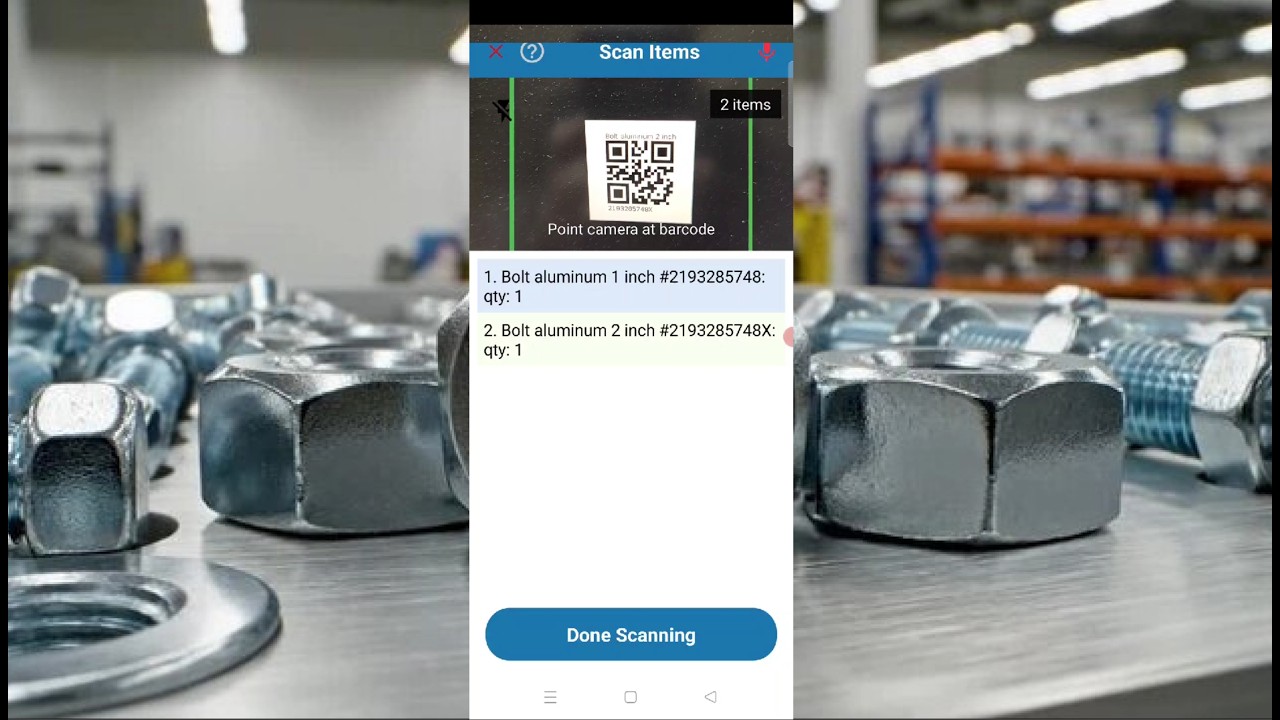
- Continuous QR Code Scanning Once transaction details are completed, employees use a smartphone camera to quickly scan inventory and assets
one after another in a single continuous stream, eliminating tedious menu clicks after each scan.
- Real-Time Sync to the Cloud Once everything is scanned, an inventory transaction is submitted to the cloud. All authorized software users
instantly get access to updated inventory stock levels and asset locations.
More on voice-enabled inventory app
See voice inventory app in action - video demo
Inventory Workflow Customization, Data Collection, and Traceability
Streamline production and ensure total regulatory compliance by configuring QR Inventory software to match your workflow, capture precise data at every stage of the product lifecycle,
and track lot numbers / serial numbers to maintain traceability.
Adapt Inventory Management Process To Your Business With Customizable Workflows
Model your existing processes with custom workflows, data fields, forms, dashboards and reports.
- Custom Transaction Types to Match Your Business Operations: Define your own transaction types, such as receiving, job site delivery, field usage,
returns, or equipment staging, to accurately map how materials move through your pipeline.
- Multi-Step Production Workflows for Assembly Tracking: Create custom workflow steps that mirror your manufacturing process
to easily track work order status and pinpoint production bottlenecks.
- Custom Data Collection to Capture Meaningful Context: Specify the exact details required at each
transaction type or workflow stage, ensuring that employees capture all info your business requires.
- Record & Report Data You Need with Custom Fields & Properties: Add custom fields, including text, numbers, dropdowns, images, and documents, to store business-specific asset and inventory data.
- Granular Traceability for Regulatory Compliance: Track items by lot number, serial number, or SKU depending on your compliance and operational needs. Maintain end-to-end traceability for regulatory compliance and fast recalls.
- Customizable Dashboards and Reports: Control which fields are displayed on the main inventory dashboard and reports, getting
instant visibility into the information that matters most.
Speed Up & Automate Paperwork With Mobile Forms and Checklists
Replace slow physical paperwork with intelligent mobile forms that your field team can complete on smartphones or tablets anywhere they work:
- Mobile App Data Collection: Field teams complete forms and checklists on any smartphone or tablet on-site as work is performed,
allowing them to easily log info without waiting until they are back at a desk.
- QR Code–Driven Form Access to Eliminate Errors: Forms are automatically linked to an inventory item, asset, manufacturing order or location with a QR code scan.
This eliminates errors and ensures that the correct form is used for each task.
- Offline Mode for Remote Field Work: Remote workers can complete forms offline in the areas with no connection. The mobile app safely stores everything locally and
syncs to the cloud when a connection becomes available.
- Organized Digital Records for On-Demand Access: Completed forms are stored as structured digital records in the centralized cloud system. Authorized software users can
search records by multiple parameters to access the exact info they need.
- Instant PDF Generation for Easy Sharing: Field technicians can turn completed mobile forms into professional, custom-branded PDFs on the smartphone when the task is completed.
PDF documents data and layout are based on predefined templates, and can include collected data, captured images & signatures.
More on digital mobile forms
Control Production Processes With WIP Tracking and Traceability
Eliminate production bottlenecks and ensure total quality control by tracking Work-in-Progress (WIP) status and component history in real time.
- Track Process Steps With QR Code Scanning: Shop floor employees track each work order as it passes through different production phases using rapid
mobile QR code scanning. This instantly
updates work order status in the central database.
- Step-by-Step Data Capture: Optionally, workers can document production details at every step. You define what data should be captured, such as measurements,
test results, quality checklists, and photos.
- Live Work Order Status Visibility: Managers always have a live view of everything in production. This
real-time WIP tracking gives manufacturers
better process control, helping prevent production bottlenecks and delays.
- Complete Work Order History: Each work order maintains a complete history of process steps, date/time, employees, what was done, and collected data.
This data provides a clear audit trail for quality control, issue resolution, and compliance review.
- Component Traceability for Compliance and Recalls: You can track components, parts, and sub-assemblies by SKU, serial number, or lot number.
You can instantly pinpoint which end-products contain a specific batch or component if a defect is discovered, allowing you to issue fast recalls and minimize recall scope.
More on manufacturing workflow tracking
Implementation, Scalability, and System Integration
Implementation, scalability, and integration features ensure that QR Inventory fits into existing environments and grows with organizational needs.
Customize Inventory Software Functionality With Add-On Modules
A modular architecture of QR Inventory software allows businesses to start with core inventory capabilities and add specialized functionality
as operational needs grow, ensuring the system scales as needed. Here are some of QR Inventory's modules:
Operations, Visibility, and Control Modules
Production and Materials Management Modules
-
BOM and Assembly Tracking - Manage BOM lists, track the building of generic and serialized assemblies.
Record lot / serial number of components that go into each serialized assembly for traceability.
Inventory stock is automatically adjusted as components are consumed.
-
Stocktaking and Asset Audits – perform physical inventory counts and audits using mobile scanning.
Financial Modules
Documentation and Media Modules
-
Images, Documents, and Signatures – attach photos, documents, and digital signatures to inventory records.
- Documents module - create customizable PDF documents for completed inventory transactions and digital forms.
Reduce Training Needs & Increase Software Adoption With Simple & Intuitive Interface
QR Inventory software is designed for fast adoption, allowing teams to start using the system with minimal training and without technical expertise.
Built-in guidance, AI assistance and timely tech support are available to help users find answers quickly when needed.
Simple and Intuitive Mobile App
The mobile app is designed for field inventory tasks, focusing on speed, accuracy, and minimal data entry.
These advanced mobile app features make field inventory tracking quick and simple:
- natural language voice queries
- continuous QR code scanning
- scan-in fields
- selection and hint lists
- smart data auto-fill
- dynamic sections that can be inserted on demand
- photo capture
- automated data capture (date/time, employee, GPS location)
User-Friendly Web Interface
The cloud software interface is intuitive, user-friendly and is designed to reduce repetitive tasks.
Guided Software Walkthrough
A guided walkthrough introduces core features and common workflows, helping companies become productive quickly without lengthy training sessions.
Scalable Software With Flexible Hosting Options
QR Inventory software is built to adapt to changing operational and infrastructure requirements over time.
- Scale Up Easily As Your Operations Grow
Scale QR Inventory up as needed by adding users, inventory items, assets, locations, and functionality, without the need for system redesign, data migration,
or operational disruption.
- Flexible Hosting and Deployment Options
QR Inventory can be hosted in the environment that best fits your organizational requirements. Choose SaaS hosting with us,
self-host on an internal network, or deploy QR Inventory on a preferred cloud provider, such as AWS or Microsoft Azure.
Reduce Manual Work By Connecting Inventory Software With Accounting and Project Management
QR Inventory integrates with financial and project management systems to keep inventory, purchasing, and project data in sync
without double entries.
Accounting and Financial System Integrations
QR Inventory integrates with accounting platforms such as
QuickBooks Online,
QuickBooks Enterprise, and
Sage Intacct
to synchronize inventory-related financial data, helping businesses maintain consistency between inventory and financial records.
Project Management System Integrations
Integration with project management systems such as
Procore and
Asana connects job site deliveries, materials and equipment usage, and field documentation to project workflows.
Data flows from QR Inventory to the project management system automatically, eliminating delays and double entries.